

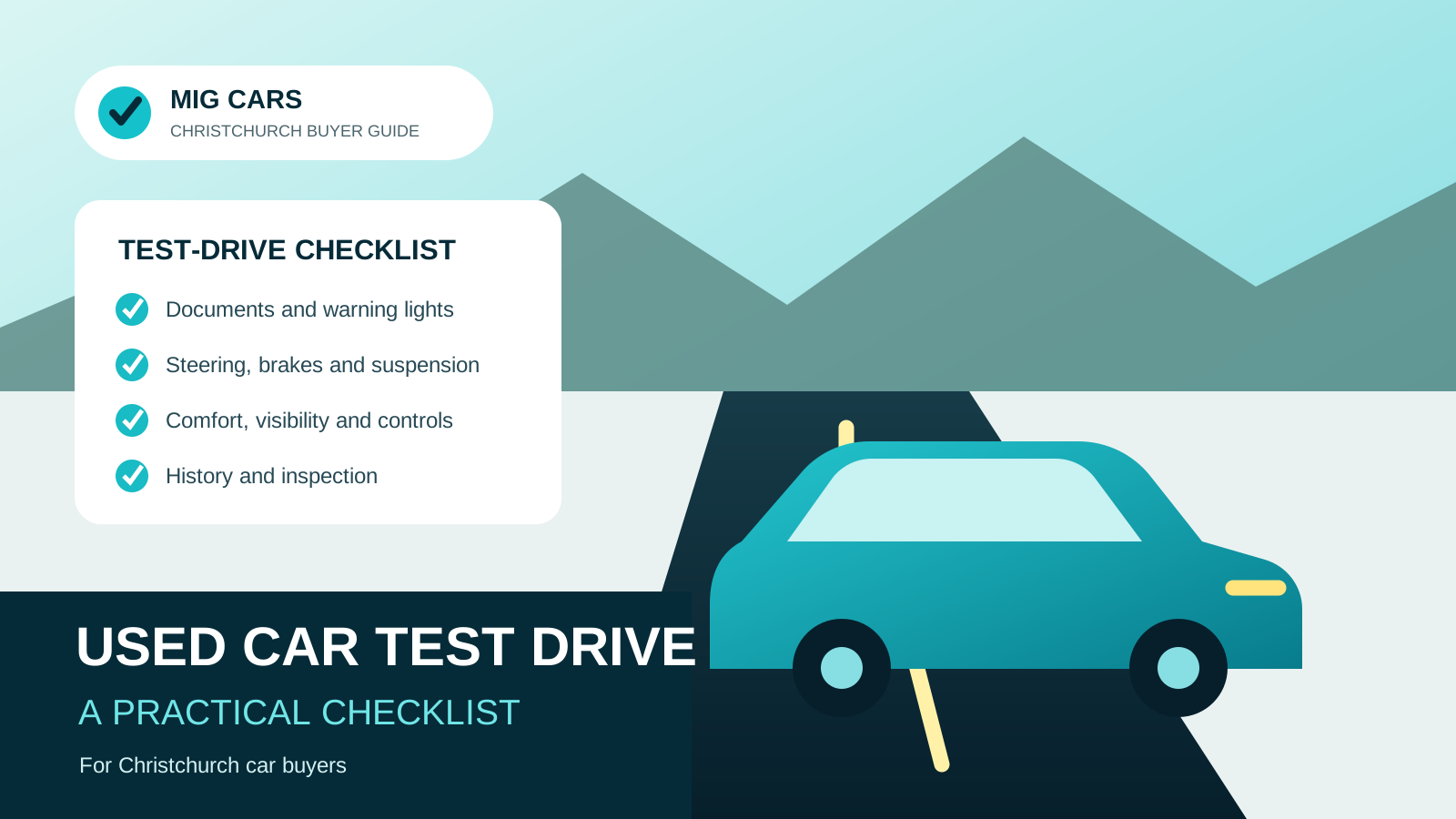
A useful test drive is more than a quick trip around the block. It is your chance to decide whether a used car suits your everyday driving and to notice signs that deserve closer investigation. Plan a varied route, allow enough time and compare each shortlisted vehicle in the same way.
Before the engine starts
Confirm that the vehicle can legally and safely be driven. Check the Consumer Information Notice where one is required, the current WoF and vehicle licence, and ask about insurance cover for the test drive. Consumer Protection's pre-purchase inspection and test-drive guide also recommends reviewing service records and asking about money owing, previous water damage and available keys.
If possible, see how the car starts when the engine is cold. A vehicle that has already been warmed up may behave differently. Walk around it first, looking at tyres, glass, lights, paint condition and the alignment of doors, the bonnet and tailgate.
Check the driving position and controls
Adjust the seat, steering wheel and mirrors before moving. Make sure you can reach the pedals comfortably and see clearly in every direction. Test the seatbelts, windows, central locking, lights, indicators, wipers, washers, demisters, air conditioning, reversing camera and parking sensors where fitted.
Switch on the ignition and watch the dashboard. Warning lights should illuminate as part of their normal check and then go out according to the vehicle handbook. Do not ignore a warning light that remains on.
Listen to the start-up
The engine should start promptly without persistent rattles, knocking, heavy smoke or unusual smells. In a hybrid or electric vehicle, the car may become ready to drive without the petrol engine running, so check the ready indicator and any system warnings. Ask for an explanation if something is unfamiliar.
Use a route that reflects real life
Include the types of Christchurch roads you normally use: low-speed streets, stop-start traffic, a faster section and, where practical, a hill or uneven surface. Check whether visibility, ride comfort, cabin space and road noise suit you. If the car will carry children, luggage or work equipment, consider the actual space and access you need.
Steering, suspension and brakes
On a safe, level road, the car should track predictably without constant correction. Notice vibration through the steering wheel, knocking over bumps or unusual tyre noise. Braking should feel consistent and controlled, without pulling strongly to one side, excessive pedal travel or persistent grinding and squealing. NZ Transport Agency's used-car buying guidance provides additional checks for steering, suspension, brakes, tyres and vehicle condition.
Transmission and power delivery
Acceleration should be smooth and appropriate for the vehicle. An automatic transmission should select drive and reverse without an excessive delay or harsh engagement. A manual clutch should operate progressively without obvious slipping or severe judder. For a hybrid or EV, notice whether power delivery and regenerative braking feel consistent, while remembering that different models can behave differently by design.
After the drive
Park safely and look underneath for fresh leaks. Check whether any warning message appeared, whether cooling fans or unusual smells need explanation, and whether all controls still work. Write down your impressions before testing another car so the details do not blur together.
A test drive is not a mechanical inspection
A current WoF shows that the vehicle met specified safety requirements at the time of inspection; it does not confirm overall mechanical condition. Consumer Protection recommends a professional pre-purchase inspection, especially when buying privately. A history check may also help identify matters such as money owing, previous damage, stolen-vehicle records or inconsistent odometer information.
Compare before deciding
Do not feel pressured to decide immediately. Compare condition, service history, safety rating, running needs, insurance, finance costs and the total amount payable. Read the sale and finance documents carefully before signing.
Ready to make a shortlist? Browse current used cars at MIG CARS Christchurch, review the vehicle finance information, or contact the MIG CARS sales team to arrange a viewing and test drive at Moorhouse Avenue or Lincoln Road.